|
The film "You must remember this ..." Like many people, I'm fascinated by World War Two, and have been since I was a kid. I have read innumerable books about the mood of America during the war. I've looked at contemporaneous newspaper accounts. I've talked to my parents and their contemporaries about what it was like then. "Did we view it as an idealistic struggle against tyranny," I have asked, "or just something we had to do because we were attacked? Was there much dissent against the war? Did we ever feel that we might lose?" I have asked all of those questions, and many more, again and again. Did all that study really affect my deepest levels of understanding? No. You can fill in some details that way, but when you really come down to it, it doesn't matter how much education you have, how much you've thought about this matter, or how interested you are. In your heart, you already know how America viewed itself at the time if you've seen Casablanca. Casablanca's Rick Blaine was more than a character. He was America: so cynical, in such control, and yet so romantic at the same time. Why would we want to re-create artificially and academically how America felt after Pearl Harbor when we have a perfect time machine that lets us look directly into that part of the past; a time machine called Rick. He speaks to us even now, across the generations, because our self-image has not changed so dramatically, and Rick epitomizes that mythological view which we Americans hold of ourselves. On the outside we are reluctant to fight, cynical, tough, uninvolved, fiercely individualistic, and not a little bit bitter. On the inside we are capable of great sacrifice, compassionate, idealistic, and savage when aroused. As Americans see ourselves, we feel free to make fun of lunatic Frenchmen with their prissy, artificial manners, but any time they need us, we're there. We consider ourselves free of the treachery that has always characterized Europeans. If we say we're your friends, well, by God, we're your friends until you cross us. Steadfast and loyal, we're the best friends and the worst enemies you could imagine, reluctant warriors who turn coldly, professionally vicious when betrayed or forced to fight. Is that accurate? Probably not, but accuracy is immaterial. It's how we saw ourselves then, and how we see ourselves still, right or wrong. Because it taps so deeply into the American male mythos, Casablanca is probably the "favorite" of more American men than any other film, and it is as popular with film scholars as it is with average viewers. It was popular in its own time as well. It won the best picture Oscar and, unlike many "great" pictures, was a solid box-office success. It had the third-highest box office total of all the Warner Brothers movies made during wartime, grossing six million dollars. To put that into modern perspective, 25 million people saw the film in an era when the population of the country was 132 million. The population of the USA is 307 million as I am writing this, so if the same percentage of the current population went to a modern movie and paid ten bucks a head, that film would gross nearly $600 million. It is also possible to argue that this film is not just a popular entertainment, but is at or near the summit of cinema's artistic achievements, given Tolstoy's definition of art as "deep, creative communication of feelings," yet it was never intended to be art at all. At the time it was viewed as "just another movie" (Lauren Bacall's words) made under the old studio system, created simply to make a buck. Unlike most enduring works, it was a group project, with no single passionate visionary behind it. You might wonder, "What about the director?", but such a thought is generated by inappropriately projecting today's moviemaking process into the past. Directors simply weren't as important in those days. Mike Curtiz was a solid director, but he was just a studio employee on a weekly salary, and was considered a hired hand. Directors were held in such low esteem by the studios that Curtiz's entire paycheck was once withheld because he made $27 in personal phone calls on the Warner telephones. He was assigned to direct the Casablanca script simply because he was not assigned to any other project when another director, William Wyler, turned Casablanca down. Even after the project got under way, Curtiz had minimal control by today's standards. He didn't even get to choose the key members of his crew. He hated the man who was assigned to be his sound editor, but had to accept him anyway. He asked for one editor, and was assigned another. He used the cinematographer the studio told him to use. That cinematographer and that editor were chosen, like Curtiz himself, simply because they happened to be free the week Casablanca started shooting. Curtiz had no input on the script either. That would have been unthinkable in those days. He never even saw the script until shortly before it was time to start filming. At Warner Brothers, directors directed and writers wrote, and they both reported to the producer. It was producer Hal Wallis who managed the writing teams and held full control of the script. He started the process by buying an unproduced stage play called "Everybody Comes to Rick's." Three weeks after Pearl Harbor, Wallis authorized Irene Lee, head of Warner's story department, to pay $20,000 for the film rights to that script. That play probably would never have entered the Warner pipeline if America had stayed officially neutral, but the bombs falling on Hawaii meant that the overseas war was now America's war, and that fact gave the project a new urgency. A story which had previously seemed to Wallis to be an exotic tale of foreign intrigue suddenly seemed like a stirring demonstration of how Americans would do the right thing when necessary. That obscure play was only the beginning. It was rewritten innumerable times, eventually involving seven different writers. Every major character who ended up in the movie was already in the stage play, and every major plot development had already been present. There was even a black pianist who played "As Time Goes By." The true genius, however, was in the refinement. In the stage version, Ilsa was a sophisticated but emasculating American slut (named Lois) who lost Rick when she cheated on him casually, and then later cheated on Victor with Rick. That amorality wasn't going to fly in the Hollywood of the 1940s. The character of Rick Blaine in the play had been a self-pitying lawyer who screwed up his marriage by cheating on his wife. That obviously wasn't Bogart's screen persona, but Bogart had been cast before the first word of the film script had been written, so the first team of studio writers, twin brothers Julius and Phil Epstein, rewrote the character to suit Bogie. Julius said, "Once we knew Bogart was going to play the role ... we tried to make him as cynical as possible." They did a helluva job. What really makes Casablanca work perfectly is the Epstein's dark comedy, which gives us permission to accept the film's sentimentality, and keeps the attitudes timeless. The bantering between caustic Rick Blaine and the garrulous, shallow, womanizing, but somehow loveable French Vichy administrator still seems brilliant today, even standing alone on a piece of paper, absent the genius of Claude Rains and Bogie:
Rick's dialogue was existentialism in microcosm:
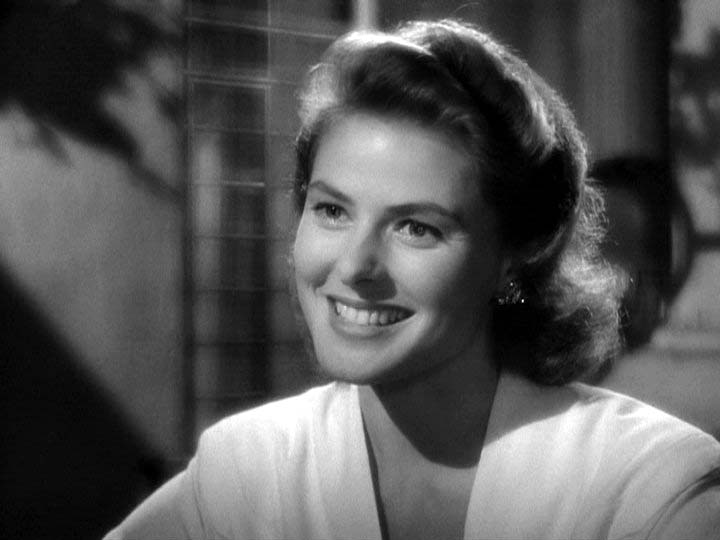
Rick's love for Ilsa is hidden beneath a veil of cynicism and some very real pain: |
|
|
|
|
|
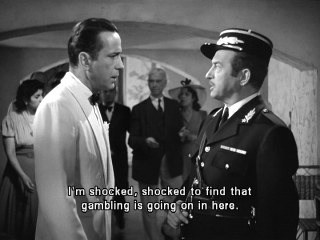
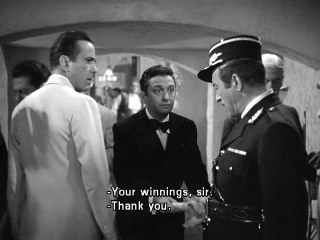
Who but the openly corrupt Louis could close a club for permitting gambling - while collecting his winnings in the same breath: |
|
|
|
|
|
And, of course, Louis's most famous line from the film, delivered after Rick has gunned down Major Strasser: |
|
|
|
|
|
The final Casablanca script was the result of an unlikely serendipity - the committee which created it had not designed a camel, but a thoroughbred horse, and not just any horse, but Secretariat! Not many movies really hold up for sixty years. We get distracted by the corny acting or the bad sound. We find them too slow. The jokes don't work. They don't move us. Not so with Casablanca. The film still makes people laugh, and it still makes tough guys mist up. But it was not just the script that made the magic. Even with the same script or one just as good, Casablanca could not be made as well today, even given all the advances in modern filmmaking. In the last analysis, the film was so powerful because of the authenticity of the war-heightened 1940s emotions and because of the unique genius of Bogart as Rick. If the sentiments were not genuine, the script would seem contrived. If Bogie had not played Rick, and thus had never inspired the Epsteins to add the cynical humor, the script could easily have degenerated into pure schmaltz. Instead it emerged as a perfect time capsule of 1940s America. When it comes to understanding the America of wartime, some people come to libraries to learn from books. Some people come to the last remaining elders who remember those days. But everybody comes to Rick's. |
|